Beatrice and Peter
“It’s easy to think of a hospice just as a place where people go to die. But it’s much more than that. It’s not just a place, but a source of support whether you end up staying in the hospice or being supported at home. And it’s not just about death, but also about living as full a life as possible, for however long there is left.”
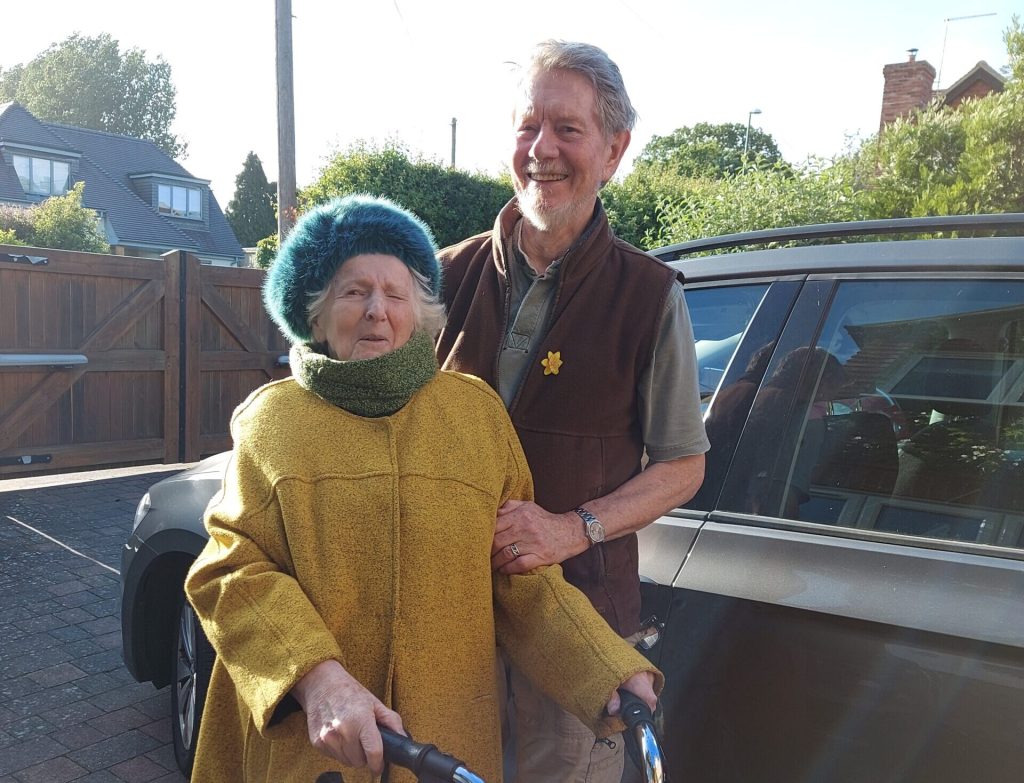
Dr Beatrice was an 83-year old lady with a history of breast cancer and Progressive Supranuclear Palsy (PSP), who received support from the St Peter & St James Hospice Community Nursing Team from April 2021 until her death in March 2025.
Peter tells us about their story and the support they received from the Hospice: “Beatrice and I met at Marks & Spencer in Shoreham, we were both selecting flowers, her to cheer herself up, me for my poorly mother, and we got talking. We bonded over the purchase of a chicken sandwich, and that eventually led to twenty years of marriage! Many years previously, Beatrice had ‘escaped’ to England from an unhappy home environment in Dublin at 18 years old, first becoming a nurse and midwife. Both Beatrice and I had academic careers, where Beatrice specialised in researching pain in the elderly, also becoming a pain clinic counsellor. I had worked in the field of operational research, using logic and maths to assess risk, and latterly worked in the Department of Health for over 20 years.
In March 2021, Beatrice had been unwell for some time, with what we thought was chronic fatigue syndrome. Whilst at a neurological appointment, we received a diagnosis of PSP out of the blue, and we were told the condition was progressive and untreatable. Until then we had never even heard of PSP. It rocked our world, but as we had always been very active socially, from those very early days, we hung on to as much of normal life as possible.
We were put in touch with the hospice that April, and we started to have home visits from one of the community nursing team, Liz Hunt. Beatrice was absolutely certain she wanted to be at home if she could throughout her illness. Initially these were visits every three or four weeks, and these became more frequent towards the end of her life. Both being from Ireland, Beatrice and Liz found an immediate connection. Beatrice was also supported by a number of specialists including a physiotherapist and a Parkinsons nurse, but it was always Liz’s visits she looked forward to most. For Beatrice, it sometimes felt like two friends having a cup of tea and a chat, especially early on. Liz was a great support to me too, reassuring me I was doing the right things as a carer, especially when Beatrice would tease me for being slow to do the jobs around the house, jobs that she so desperately wished she could still do.
In Autumn 2022 I suffered a major stroke, and ended up in hospital for two months. Family rallied round, and as we had a contingency plan in place should anything happen to me, a live-in carer came at short notice to support Beatrice. We carried on having a carer once I had completed my rehab and came home. This was a great practical help, though not without its challenges. It could be hard having someone living in our house and doing things differently. Although on one hand I wanted to be able to just spend our time together as ‘husband and wife’, all my instincts were to step in to be her carer too. It could be exhausting.
As Beatrice’s condition deteriorated, her mobility got worse and she stared to lose her speech. Liz would always make her visit fit what Beatrice could manage, whilst still encouraging her to not give up. It might have been a very slow walk around the garden talking about the flower blooms, admiring Beatrice’s art on the walls, or a casual chat on the sofa.
There were so many additional acts of support and kind gestures from Liz and the hospice team. Beatrice had massage sessions at home which were always well received. Sometimes, apparently small things, could make a big difference. When it became necessary, Liz delicately persuaded Beatrice to wear incontinence underwear, showing her types that looked and felt as “normal” as possible. This saved many washing loads and constant trips to the loo and back. More critically, it helped preserve Beatrice’s dignity, and allowed us to bring back some bits of normal life, like going on a drive or out for a pub lunch. We already had some “end of life” paperwork in place – Wills, Enduring Power of Attorney etc, – but Liz also helped Beatrice complete a “respect” form to ensure that her wishes for future care; staying at home and declining some potential forms of life-prolonging treatment, were clearly on record. As Beatrice’s symptoms worsened, Liz explained and guided us through the application for NHS Continuing Health Care (CHC) funding to cover the cost of the live-in carer. The successful application saved us many thousands of pounds and removed financial worry.
Since Beatrice died, I have had some weekly bereavement counselling sessions at the hospice with Samantha. They have really helped to reserve a space to talk through the long journey we travelled when Beatrice was ill, and her death.
Beatrice’s three children; Joanna, Joshua, and Esther, and I, are so grateful for all the support we have received over the four years that the hospice has been in our lives. Above all else, they helped give Beatrice what she had wanted at the end, and in the face of a horrible and cruel disease, to be at home with me and all her children. To the extent a death can be a good death, I really think it was.”
If you’d like to discuss our current volunteer vacancies, then please email us at volunteering@stpjhospice.org, call us on 01444 471 598 or use our contact form.
